Imposing Limits for Speed and Distance: C*SARA price for mobility is traffic congestion. It causes much damage to economy but also reduces traffic safety and the reliability of the road network. My project deals with the reduction of congestion and the enhancement of safety.The thesis of this project is that traffic congestion can be avoided or reduced if we consider traffic to have the same characteristics as a fluid; smoothing the traffic flow by gathering traffic data, constructing models and than establish an ideal speed and minimum distance between the cars. Also the enhancement of traffic safety is important so various parameters like the avarage speed, volume and weather data are important for setting the standards. It seems that people tend to react on a more or less ideal traffic situation rather homogeneously but on a situation which is far from ideal like at night or extreme weather conditions, people do react very differently from each other so accidents are very likely to happen. The challenge of this project lies in the communication of a minimum distance limit for drivers. And not only the communication of a limit but also giving the drivers a �device� with which they can evaluate their own actions is needed. The proposed system consists of various subsystems: Traffic Data CollectionA video-camera is the primairy source of traffic data. My promotor, Mr Versavel, is manager of Traficon (Kortrijk, Belgium), a firm that manufactures camera�s for traffic management. Their expertise is in the development of software and algorhythms required to translate the video-images into traffic data.Weather Data CollectionThis subsystem is devided in two partsa Fogdetection: an infra-red sensor measures fog-density b Frost-, Raindetection: a system that is used by Rijkswaterstaat (the Netherlands) makes use of various sensors like thermometers, hygrometers and semi-conductors to detect dangerous situations like frost or heavy rainfall. Standard Protocol and Processing:The incoming data will be evaluated and compared with standards for speed and distance on the given situation.In-Car System:A build-in transponder receives the speed limit and distance limit from transmitters stationed above the road and gives the driver a warning if he exceeds the limits. This will be a good supplement to autonomous cruise control because these systems can not react on changing external situations; for example different traffic or weather parameters.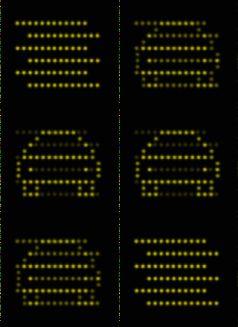
Information Transfer:The speed limit appears on a Variable Message Sign. The minimum distance limit will be communicated via a VMS which gives the prescribed distance in metres and a symbol that explains the concept of keeping distance. Finally, a �device� is needed to give the drivers help by the evaluation of their own actions.After examining the different possibilities and evaluating them on different criteria, I found that the appropriate place for such a �device� is the road surface. Of course there are many options for this solution: Remote Controlled Road Studs:Every 5 or 10 metre has a small light made of 6 LED�s. All these luminous road studs are connected with one flat cable taped on the road. The studs are controlled by a small processing unit which is directed by the central processing unit. Each one of the studs can be put on or off.The studs consist of an electronic part (with an IC and the LED�s) and a cover to protect the electronics from heavy traffic. The electronic elements are water-resistant. The installation on the road consists simply of taping the cable and the road studs on the road surface. This system provides the drivers with adequate information without the risk of exposing them to unnecessary information. A water-resistant connection of the LED�s on the cable is needed. The requirements are also durability for 5 years and weather-resistance. |
|




